Aryan Singh Sengar

Builder · EV charging, AI agents & robot learning

17, from Khajuraho, India. I build software and like solving hard problems that look like science fiction today.

About

Hi, I'm Aryan. I'm seventeen, from Khajuraho, a small town in India. I build software and like solving hard problems that look like science fiction today.

I work under cost constraints on purpose, so that what we make stays affordable for both makers and users, not a luxury. Right now I want to test low-cost wireless EV charging through highway guardrails: that's Maglion.

I'm also building Agentidin, a hybrid agentic professional network, and Kinux, my research on cross-embodiment robot learning. I also built Wynko with a team I recruited from Reddit. I taught myself to code in a notebook, with no computer at home, and I still learn fastest by building rather than reading theory.

Experience

  1. Founder · Maglion

    Wireless EV charging built into highway guardrails and median barriers, with charging pads for cities, powered by solar panels along the roadside. My computer simulations show it cutting battery, operating and building costs. I recently applied to Emergent Ventures for a grant to build the prototype.

    • Wireless Power
    • Simulation
    • Solar
    • Hardware
  2. Founder · Agentidin

    A hybrid agentic professional network, started after struggling to hire the right people for Wynko. Every person and every company gets an agent; agents find matching skills and talk to each other, so hiring is faster and doesn't need an expensive recruiter seat.

    • AI Agents
    • Hiring
    • Product
  3. Researcher · Kinux

    Cross-embodiment robot learning: classifying robots by how well their parts transfer to one another, so a robot can learn from the best-matching donor type, and building an SDK for robot failure logging that captures what happened when something goes wrong.

    • Robotics
    • Simulation
    • SDK
    • Research
  4. Founder · Wynko

    A Windows desktop app, Android app, Focus Lock browser extension and website, built on a low-level kernel system, that help people stay away from distractions while studying. Recruited a team from Reddit to build it alongside me.

    • Windows
    • Android
    • Kernel-level
    • Browser Extension
  5. Founder · Agency

    Ran an agency with a team of 4 to fund Wynko's development: website development, tools, and social media handling for clients, including shopkeepers. The capital it generated paid for our development tools and stipends for the team.

    • Team of 4
    • Web Development
    • Social Media
    • Client Work
View Full Résumé

Projects

  • Maglion — wireless EV charging in guardrails

    Charge the car while it drives: solar panels feed coils inside the guardrail, which pass energy across the gap to a coil on the car's side, like wireless phone charging at road scale. If cars charge as they drive, they could carry a battery up to half the size (my estimate from simulations, not a measured result).

    Wireless dynamic charging has already been done by an Israel-based company; the problem is set-up and maintenance cost, because the road is dug up. Mounting coils in existing guardrails aims to cut that by 3× to 5× (a target, not yet proven). My computer simulations show Maglion cutting the cost of the battery, of operation and of building the infrastructure. I've recently applied to Emergent Ventures for a grant to build the prototype; next is a low-cost bench test and a power-electronics partner.

    • Wireless Power
    • Solar
    • Simulation
    • Not yet built
    Maglion logo: Beyond Roads
  • Agentidin — a hybrid agentic professional network (in development)

    Hiring for Wynko, I kept struggling to find people with the right skills. On Agentidin, every person has their own agent: bring one (for example from OpenClaw), connect one through AI tools like Cursor, ChatGPT or Claude, or make one on the platform. The agent builds your profile from your GitHub projects, Codeforces and skills you verify, so you're always represented, even when you're offline.

    Companies get an agent too, connected to their company brain and Slack. With a Claude tag or a command, they describe the skills they need, and their agent finds matching people's agents. Agents talk to agents, agents to humans, and humans to humans, without paying for an expensive recruiter seat like LinkedIn's, which early-stage startups and companies in developing economies struggle to afford. The goal: cut hiring time sharply by being autonomous, while staying human-friendly.

    • AI Agents
    • Hiring
    • Slack
    • GitHub
    Agentidin logo
  • Kinux — cross-embodiment robot learning (research in progress)

    Moving what one robot learns to a different robot type is a big bottleneck for robotics. My idea: classify robots the way Carl Linnaeus classified living species, grouping them by how much one robot's parts (motors, joints, torque) transfer positively to another.

    Early result: I randomised combinations of parts from multiple robots and matched which parts give the most positive transfer, then stress-tested the combined result. So far this beats transferring a whole robot to another whole robot. These are early results and may change as I test more.

    • Robotics
    • Transfer Learning
    • 3D Simulation
    Kinux logo
  • Wynko — focus tools for studying

    Windows desktop app, Android app, Focus Lock browser extension and website, built on a low-level kernel system, that help a person stay away from distractions while studying, giving breaks and blocking autonomously. Development was funded by an agency I ran with a team of 4. Live at wynko.in.

    • Windows
    • Android
    • Kernel-level
    • Extension
    Wynko logo: Focus, Study, Together
  • Low-cost AI coding setup

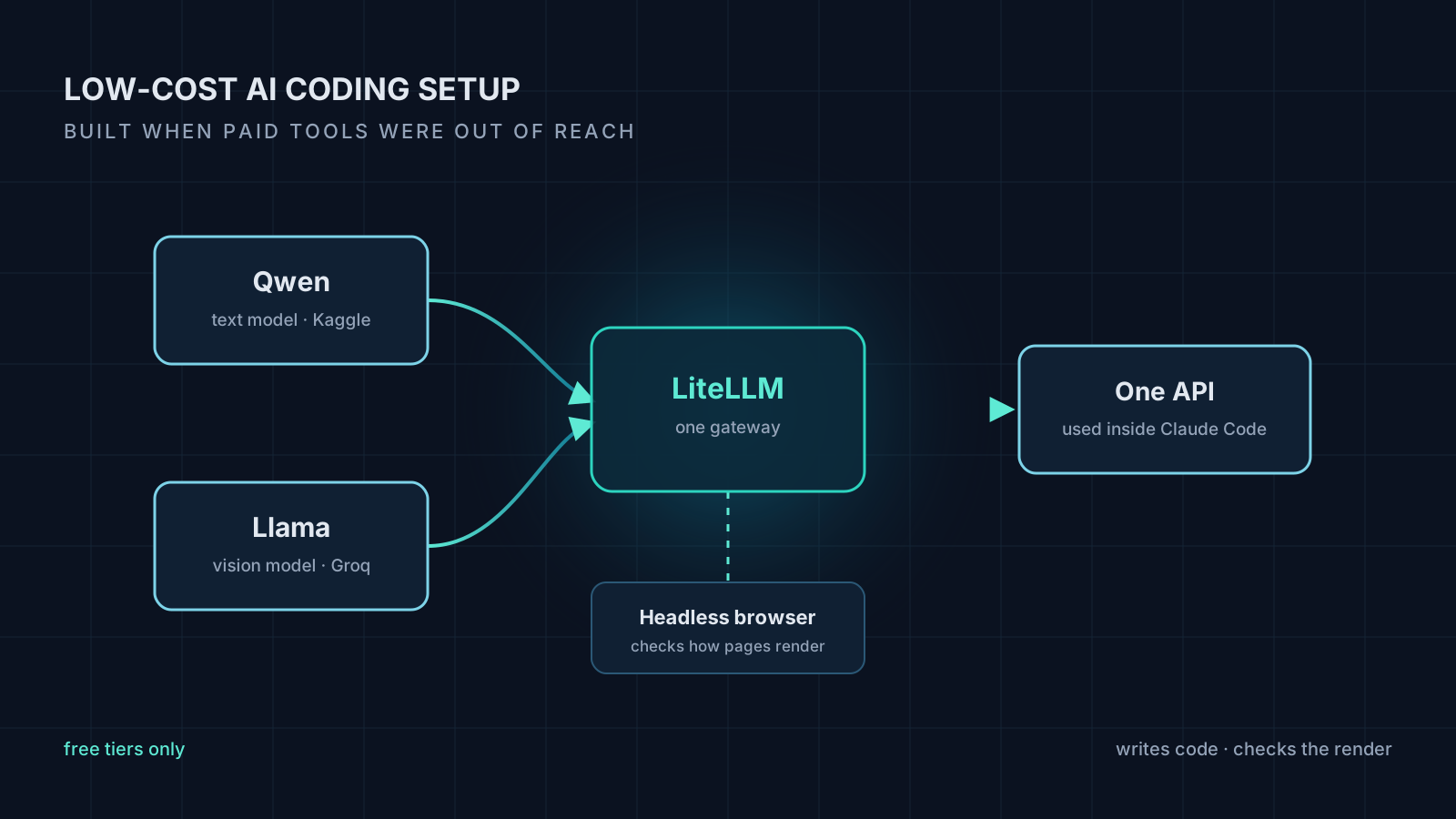
    Built when I couldn't afford paid tools. Open-source models on free cloud notebooks like Kaggle, with Qwen as the text model; LiteLLM as the gateway; Llama on Groq's free tier as the vision model; and a headless browser. The text model writes the code and the vision model checks how the page renders. Wrapped as one API endpoint and used inside Claude Code.

    • Qwen
    • LiteLLM
    • Groq
    • Kaggle
    Pipeline diagram: Qwen and Llama joined by LiteLLM, wrapped as one API
View GitHub

Story

  • 4th standard

    Coding in a notebook

    No computer at home. I wrote programs in a notebook and ran them on school computers.

  • School years

    200 to 300 programs a day

    I loved it so much that my computer teachers began asking how I was able to do it.

  • After 10th standard

    My own computer

    Since then: Linux, Java, Python, Rust, Kotlin, Android and Windows apps, HTML, CSS, Tailwind, Next.js, Figma, and orchestrating multiple AI agents at a time.

  • IISER Aptitude Test

    Rank 3846

    The entrance exam for India's premier research institutes: the IISERs, and also used by IISc and IIT Madras for their BS programmes.

  • School

    Debating

    I love debating, and won several debate competitions in school.

Time travel

Where it started

Before this site, there was a notebook. I wrote programs on paper and ran them on school computers, years before I had a computer of my own.

  1. 4th std

    Programs written in a notebook, run on school computers.

  2. School

    200 to 300 programs a day, until teachers asked how.

  3. 10th std+

    My own computer. Wynko, and an agency with a team of 4 to fund it.

  4. Now

    Maglion, Agentidin and Kinux. You are here.